
Cooking School: Know Your Knives
Now that we’ve covered safety in the kitchen, let’s get straight to the next important topic in our cooking school series: Tools, and more specifically, knives.
Simple Bites reader Alissa writes:
One question I have is about choosing the right tools during prep work. I know my default is to select the smallest item (knife, bowl, etc) that will do the job, but it seems the chefs on television are always using huge bowls for tiny tasks, and 8-inch chef knives when I’m pulling out the paring knife.
I’d love to know what they teach about that in cooking school.
Great question, Alissa! Most people don’t realize is that using the correct knife can actually improve your cooking by:
• giving your food the appropriate texture
• accomplishing tasks more efficiently
• respectfully treating the food product
• helping you work in a safer manner
Without question, the knife is the most important tool in the kitchen and choosing the right knife for the job is an important step toward simplifying your cooking.
The wrong knife choice can cause unnecessary bruising, mess and damage to the food product. Just as you wouldn’t use a rake for a delicate garden transplanting task, you shouldn’t use a bread knife to carve a roast.
Also, in choosing a knife that will give you the best control, you will avoid injuries caused by slipping or unnecessary added pressure.
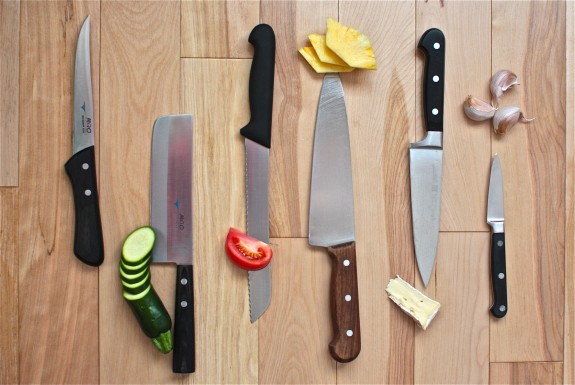
Know Your Knives
Here are the most basic knifes and their recommended functions.
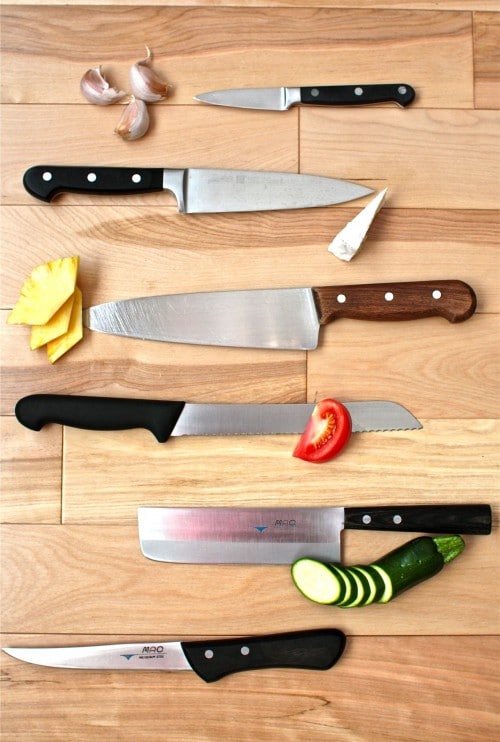
Paring
A short knife, with a blade between 2-4 inches. Handy for dozens of small, delicate tasks throughout the day such as peeling garlic, trimming mushrooms, and slicing small fruits like strawberries.
Utility
A medium-sized all-purpose knife, with a blade generally 6-8 inches long. Ideal for common kitchen functions such as cutting cheese, chopping fruit and vegetables, and slicing fish.
Chef
A larger all-purpose knife, with a 8-14 inch blade. Considered the quintessential kitchen knife for general tasks, this knife is useful for making classic cuts such as julienne, dice and fine chop and can be used for fruits, vegetables, meats and fish. Once you are comfortable with a chef knife’s size and weight, it can be used for a wide variety of kitchen tasks from chopping delicate herbs to shredding a head of cabbage.
Serrated
Most commonly known as a bread knife, the serrated slicer also works best for foods with a tender center, yet a firmer ‘crust’, such as a tomato or a ripe melon. The wavy blade allows controlled cuts that slice through the outer edge with ease and does not crush the interior. Be sure to reach for this knife to cut and serve delicate desserts with flaky pastry or meringue.
Santoku
This multi-purpose knife of Japanese design is perfect for slicing, dicing and mincing vegetables. Can be used as an alternative to the chef’s knife and is popular for those with small hands or anyone who finds a chef’s knife overly heavy. I love my MAC for thinly slicing fish and for that dreaded task of chopping onions.
Boning
A very sharp, thin bladed knife used for trimming fat and carving meat off of bones. Usually 5-7 inches long, the blade may be flexible or rigid.
Final reminder
We’ll look at specific cuts and knife work in a future post, but for now you’re on the right track to choosing the best knife for the job.
Ultimately, you should feel comfortable with the knife you are using, but don’t expect to without sufficient practice. Most of the chefs Alissa refers to in her question above have been using a chef’s knife for a long, long time and are capable of comfortably performing nearly every kitchen task with it in hand.
For the home cook I recommend using each knife for it’s appropriate task and taking the time to practice knife skills.
Now remember, keep those knives sharp!
They are the most important tool in your kitchen, but knives are often misused and mistreated. Do you hold yours in high esteem? What other knife tutorials would be helpful for you?


Great write up!
I now live with a kitchen junkie, so knives are aplenty; before that I had my one trusty santoku that I received as a Christmas present and a few pairing knives. It really does make all the difference in the world to have the right knives for the right tasks now.
I’m curious to know how you feel about knife storage? I like the look of the magnetic strips, but I’ve heard they can damage the knives over time. Any other suggestions for limited counter space?
.-= Cafe Novo’s last blog: Syrups, Trade Show and Keeping Busy. =-.
Hi Liz,
I use magnetic strips because a) they free up counter space b)they make the knives easily accessible and c) I like to display my knives.
I don’t know about the damage they do to knives, I haven’t heard anything about that.
I love my Santoku knife and must confess I use it for most things, simply because I’m comfortable with it. My paring knife is a trusty friend too. I second the question about storage and I’ve often wondered what’s the best way. I work in catering with a professional kitchen and the knives are stored in a drawer, all together. I have a knife block at home, but also like the idea of a magnetic strip to create a little more counter space and to keep them high up from small fingers. Thoughts?
.-= Jan (Family Bites)’s last blog: Butter Tart Muffins and a Love Story =-.
See my response above, Jan.
Aimee, I would love to learn how to properly prepare a fish. I love eating fish, but I’m so intimidated about how to cut it correctly that I usually reserve eating it for when we go out to eat. So that’s what I would love a tutorial about!
Thanks for the knife 101 prep today. Great post!
OK, Tsh. Perhaps we’ll look at preparing some sustainable fish in the near future. Thanks for the input!
This is a great post. I would even go as far as to say that you could even make do without a utility knife and boning knife. Of course, I do have plans to eventually get those two types for my kitchen, but I can easily cut meat/veggies with the chef/santoku.
I was hoping we would cover knife storage as well. I know that I’m doing to ultimate no-no right now by storing my knifes loose and uncovered in a drawer (they are lined up neatly without clutter on top of them). I think it would be great to cover the different types of knife storage (counter top knife blocks, in-drawer knife blocks, individual covers/casings, magnetic racks, etc.).
Also, related to knives and another good idea for a future post, could we cover different types of cutting boards (glass, plastic, wood, paper composite, etc.)? We could list the pros and cons of each type.
Hi Kara-
Yes, not every kitchen needs a boning knife, or even utility for that matter. I am not saying these featured knives are must have’s, just demonstrating what they are used for!
I’d say most ppl could do very well with three good knives: paring, chef and serrated.
Thanks for the suggestions. I could write and entire knife blog, there is so much to cover! Using the right cutting board is important too. I’ll look into it!
Great tips Aimee.
I personally wouldn’t use a pairing knife for garlic (I prefer the ‘smash and peel’ method with the chef knife).
I’ve also found I prefer a “really” sharp chef’s knife for cutting bread and pastry. It doesn’t chew up the edges like a serrated knife does. Serrated knifes also get dull quickly, and can’t be sharpened easily.
On another note, when choosing a chef’s knife, I would take into account one’s size (esepcially the hands). I’m more comfortable with a 8-inch knife than a 12-inch any day. And don’t forget a good steel to hone your knives! It’s an easy enough skill to practice, and it’s well worth the investment to keep the edge on your blades in between sharpenings.
Any suggestions on frequency for sharpenings?
This is so great for a novice like me! Thank you! My husband will be thanking you, too now that he won’t have to keep hearing me refer to the knives in our block as “the little one” “the big one” and “the bread one” 😉
The next time I have to slice a tomato, I’m going to reach for the serrated knife now.
Thanks for another great cooking school lesson!
.-= Kara’s last blog: Book Review: Love Your Heart by Tim McGraw and Tom Douglas =-.
I love my chef knife. It took me a while to get used to handling it, but now I use it for everything. Looking forward to seeing the rest of the posts in this series.
.-= Rana’s last blog: First signs of Spring!!! =-.
Love the post! I had a Swiss chef in culinary school tell me that the only knives you need in the kitchen is a paring knife and chefs knife. Other than that he would consider you “vimpy, vimpy, vimpy.” My mother uses a serrated knife to cut onions-and it drives me BONKERS!!!
I consider myself a knife snob. Love all of my knives!!! They are like my little kitchen babies!
Tell me about it…..my girlfriend does the same. Tried suggesting to her a nonserrated one will work better. Absolutely does nor listen…gees how do you persuade a woman to do anything?
I’d love to see a step-by-step of how to cut up a raw chicken.
Love this knife post!! Would be very interested in a tutorial on sharpening knives…I have fantastic knives, but they’re getting a bit dull and I’m needing to use more pressure than should be necessary to cut. Thanks!! 🙂
.-= shelley’s last blog: 12 of 12: The March Edition =-.
I have the same MAC knife that I use for every job in the kitchen- works wonderfully!
Thanks Amy! When we first got married, I would always grab the smallest knife possible – drove my husband crazy! Over the years, I’ve slowly gained the confidence to move to the larger knives. Now, I’m much more likely to grab our small chef’s knife for chopping and dicing instead of trying to slice an onion with a paring knife that won’t reach all the way through. =)
.-= Alissa’s last blog: Things that bring us joy =-.
I use probably two of the 12 knives we own. I guess once in a blue moon I use the serrated knife. But I have a smallish santoku and something a little bigger than a paring knife that cover 99% of my slicing/chopping needs. Actually, I think that knife is a steak knife, because there are four of them. Who knows…it works for me. 🙂
.-= Nikki Moore’s last blog: eating healthy + saving money =-.
Thanks Amy for a truly excellent blog post. A good set of knives is essential for any kitchen and they can make cooking so much more productive and enjoyable if you have the right tools for the job. Sure this will help people when buying new knives and knowing which types is used for what.
All kitchens must have a set of good quality knives. Thanks for the article. Please visit my military surplus stores website for more on knives.
It’s good to have a “multi-use” knife in the kitchen, but I agree that certain knives are just better for certain uses.
Love the knife post. I’ve got a few knives I’ve owned for 35 years. They’re carbon steel. I keep them sharp by stroking along a stone once a week or so and they’ve been giving me excellent service.
The question: I find that they often rust. Is the only way to prevent that to wipe with a paper towel that’s had a drop of oil dropped on it? I sometimes do that, and it works, but it would be great if you had a thought about what would work that doesn’t require the towel, drop, wipe, etc. I’m looking for something like seasoning the knife, like I did w/ my cast iron skillets.
Thx.
WOW! This one is certainly an ultimate guide to choosing the right knife.
Just wanted to ask a question, are there any universal kind of knives available?
-Ashaya
I actually use a serrated steak knife for cutting tomatoes, I find that does a great job at cutting super-slim slices without crushing the tomato.
Thanks
Mark
Yeah a steak knife definitely can cut thin slices of tomato, but you’ve gotta go slow as a snail or you just end up squishing it. It’s much easier to use a super sharp non-serrated blade.
Your Mac knife is a nakiri not a santoku and only half of knives you’ve shown are actually the knives you should own (chefs,paring,bread).
You could own all of these knives if you work in a professional kitchen.
informative post, i usually use santoku knife for almost everything i am cutting to prepare a meal. but after reading this post i should probably add a boning knife to the mix. cheers!
I’m a retired Knife maker and amateur chef, so to speak. Been doing 90% of the cooking for 60 years. anyway, they say form follows function. And I find this to be especially true when it comes to knives. Right tool for the job is best. So don’t open paint cans with butter knives. Yes, it may work. But when the wife gets home, she will wonder how in the world did the paint get on the butter knife. Educate yourself, be mindful and watch your fingers!
Such a helpful information. I have a BLACK+DECKER EK700 Electric Carving Knife and it makes me unsatisfied because of its awful trigger system
The eCom Success Academy is in its matchless league.